

Guidelines for environmental care and protection are as follows:
- Establish environmental policies and practices to comply with relevant laws and regulations, as well as international standards, focusing on efficient service provision, coupled with reducing environmental impacts and valuable resource utilization through the concept of circular resource use for maximum benefit.
- Instill awareness and promote environmentally friendly behavior to employees at all levels, by promoting economical and appropriate energy consumption, such as efficient use of electricity and water, waste and refuse segregation, as well as promoting guidelines for reducing and managing greenhouse gas emissions, to support long-term environmental impact reduction.
- Systematic environmental management through continuous monitoring, evaluation, and reporting processes for consistent improvement and development, including collaboration with trade partners and business allies to elevate environmental standards throughout the value chain.
- Communicate environmental policies and practices to ensure employees and stakeholders throughout the value chain are fully informed. The Board of Directors and management are committed to continuously overseeing and supporting the implementation of these policies to achieve the established environmental goals.
Greenhouse gas management plan
The Company prioritizes conducting business while simultaneously reducing environmental impact. It has established environmental targets for both the short term (1–3 years) and long term (5–10 years) under an international standard framework for greenhouse gas emission management. These targets are divided into three scopes: direct emissions from the organization, indirect energy consumption, and indirect emissions from the supply chain and other activities, aiming to become a sustainable organization and align with Carbon Neutrality and Net Zero Emissions guidelines in the future.
Scope 1: Direct Emissions from the Organization (Scope 1)
Short term (1–3 years)
The Company aims to reduce fossil fuel consumption from internal operations by gradually converting some vehicles to Electric Vehicles (EVs) and Hybrid Electric Vehicles (HEVs) to enhance energy efficiency and reduce greenhouse gas emissions from business travel. The Company has established a continuous vehicle conversion plan based on suitability and technological readiness.
Concurrently, the Company implements systematic waste management projects, such as waste separation at the source, promoting reuse, and donating usable items, to increase the recycling rate and reduce the amount of waste sent to landfills, thereby supporting the organization's overall environmental impact reduction goals.
Long term (5–10 years)
The Company aims to convert 100% of its organizational vehicles to Electric Vehicles (EVs) and develop the organization into a Green Office with a comprehensive waste management system, such as Zero Waste to Landfill.
Scope 2: Indirect Emissions from Energy Consumption (Scope 2)
Short term (1–3 years)
The Company aims to reduce electricity consumption in its offices by at least 5% through energy efficiency measures, such as campaigns to raise awareness about energy saving and the selection of high-efficiency equipment.
Long term (5–10 years)
Expand the target for electricity consumption reduction to at least 10%, while also studying the feasibility of using alternative or renewable energy to increase the proportion of clean energy in business operations.
Scope 3: Other Indirect Emissions (Scope 3)
Short term (1–3 years)
The Company has established supplier selection guidelines, considering sustainability factors, including environmental, social, and governance (ESG) practices, as part of its procurement process.
Long term (5–10 years)
The Company aims to foster collaboration with trade partners and business allies to collectively reduce greenhouse gas emissions throughout the value chain and continuously develop mechanisms for carbon monitoring and reporting.
Setting other greenhouse gas reduction targets
Details of setting other greenhouse gas reduction targets
| Greenhouse gas emission scope | Base year(s) | Short-term target year | Long-term target year |
|---|---|---|---|
| Scope 1 | 2024 : Greenhouse gas emissions 39.71 tCO2e | 2025 : Reduced by 5% in comparison to the base year | 2030 : Reduced by 10% in comparison to the base year |
Greenhouse Gas Management for Reduction
The company recognizes the importance of greenhouse gas management, a critical factor affecting climate change and long-term business sustainability. It has established guidelines for managing greenhouse gas emissions from its operations, covering direct emissions (Scope 1), indirect emissions from energy consumption (Scope 2), and other indirect emissions (Scope 3). The company has also set targets to achieve Carbon Neutrality and Net Zero GHG Emissions by 2030.
The company implements greenhouse gas reduction measures by enhancing energy efficiency, reducing fossil fuel consumption, and transforming organizational travel patterns. This includes adopting electric vehicles (EVs) and hybrid electric vehicles (HEVs) to replace fossil fuel-powered cars, as well as developing work processes to be efficient and aligned with sustainable development guidelines.
Operational Performance
The company utilizes the SET Carbon system, developed by the Stock Exchange of Thailand, as a tool for managing and calculating its Carbon Footprint for Organization (CFO). This system systematically collects, stores, and processes greenhouse gas emission data from the company's operations in a transparent and verifiable manner. The system enables the company to comprehensively assess the impact of its business activities, covering two main types of activities:
- Use of company-owned vehicles (Scope 1)
- Electricity consumption in offices (Scope 2)
| Number | Activity Inventory | Activity Name | Scope |
|---|---|---|---|
| 1. | Use of Company-owned vehicles and/or have control over activities such as picking up and dropping off employees, business travel, loading goods for corporate activities, etc. | Monthly fuel consumption for operational activities | Scope 1 |
| 2. | Electricity use | Office electricity consumption | Scope 2 |
In 2025, the company's total organizational greenhouse gas emissions amounted to 105 tons of carbon dioxide equivalent (tCO2e), with the following emission proportions:
- Scope 1 (Direct Emissions): 22 tCO2e, accounting for 20%
- Scope 2 (Electricity Consumption): 83 tCO2e, accounting for 78%
Compared with the 2024 base year, when Scope 1 GHG emissions were 39.71 tCO2e, the Company’s Scope 1 emissions decreased to 22.00 tCO2e in 2025. This represents a reduction of 17.71 tCO2e, or 44.60%, exceeding both the short-term target of 5% and the long-term target of 10%. This performance demonstrates the effectiveness of the Company’s operational GHG emission reduction measures.
These achievements result from key measures, including the gradual transition of vehicles from fossil fuel systems to electric vehicles (EVs) and hybrid electric vehicles (HEVs), enhancing energy efficiency in offices, and promoting efficient resource utilization behaviors within the organization.
| Category | 2022 | 2023 | 2024 | 2025 |
|---|---|---|---|---|
| Number of Internal Combustion Engine (ICE) Vehicles | 5 Vehicles | 5 Vehicles | 4 Vehicles | 4 Vehicles |
| Number of Electric Vehicles (EVs) / Hybrid Electric Vehicles (HEVs) | - | - | 1 Vehicle | 2 Vehicles |
| Percentage of EVs to Total Fleet (%) | 0% | 0% | 25% | 50% |
The company will continuously monitor, evaluate, and develop greenhouse gas reduction measures, with a focus on managing electricity consumption (Scope 2), which is the primary source of emissions. This is to support the achievement of Net Zero GHG Emissions by 2030 and foster long-term sustainable growth.
GHG Emissions Reduction Breakdown by Transition Plan Measure
The Company implements two key measures under its transition plan: transitioning from fossil-fuel vehicles to electric vehicles (EVs) and hybrid electric vehicles (HEVs), which is linked to the reduction of Scope 1 GHG emissions; and improving office electricity efficiency, which is linked to Scope 2. Together, the reductions across both scopes amounted to 19.04 tCO2e compared with the 2024 base year.
| Key Measures | Scope | Base Year 2024 | 2025 | Emissions Reduction | Share of Total Reduction |
|---|---|---|---|---|---|
| Transition from fossil-fuel vehicles to EVs/HEVs and reduced fuel consumption | Scope 1 | 39.71 tCO2e | 22.00 tCO2e | 17.71 tCO2e | 93.0% |
| Improved office energy efficiency and reduced electricity consumption | Scope 2 | 84.33 tCO2e | 83.00 tCO2e | 1.33 tCO2e | 7.0% |
| Total | Scope 1 and Scope 2 | 124.04 tCO2e | 105.00 tCO2e | 19.04 tCO2e | 100% |
Diagram of Performance and outcomes of greenhouse gas management
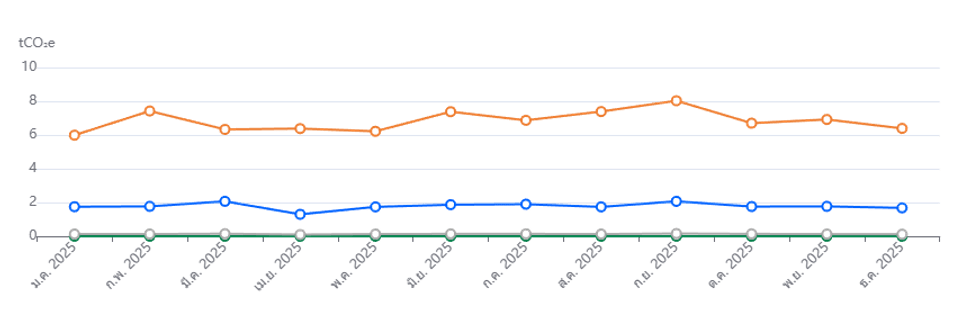
Greenhouse gas emissions by scope
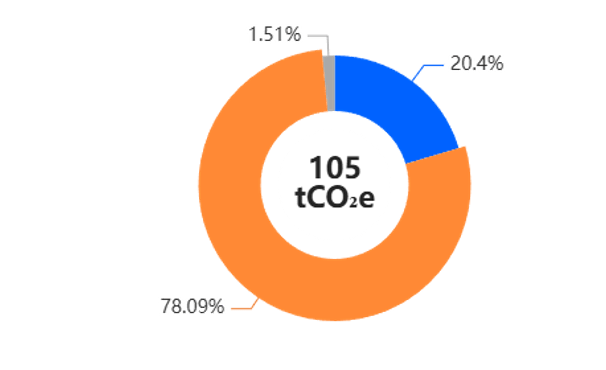
Proportion of greenhouse gas emissions by scope
Greenhouse gas management : Corporate greenhouse gas emission
| 2023 | 2024 | 2025 | |
|---|---|---|---|
| Total greenhouse gas emissions (Metric tonnes of carbon dioxide equivalent) | N/A | 124.04 | 105.00 |
| Total greenhouse gas emissions - Scope 1 (Metric tonnes of carbon dioxide equivalent) | N/A | 39.71 | 22.00 |
| Total greenhouse gas emissions - Scope 2 (Metric tonnes of carbon dioxide equivalent) | N/A | 84.33 | 83.00 |
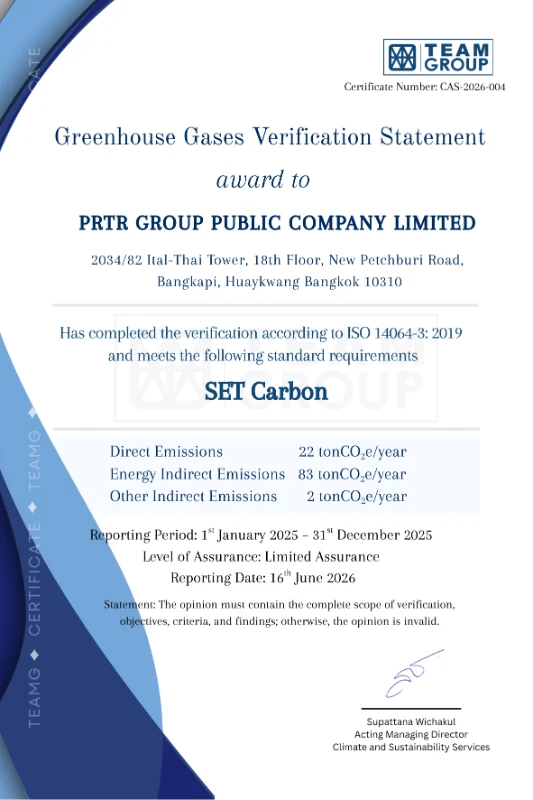
* Note on the Restatement of 2025 Greenhouse Gas Emissions Data
The 2025 greenhouse gas emissions data disclosed in the Form 56-1 One Report were prepared before the external verification process was completed.
Following the verification, the Company restated its greenhouse gas emissions data under the operational control approach. The verified emissions comprised 22 tCO2e of Category 1 emissions and 83 tCO2e of Category 2 emissions. The total verified organizational carbon footprint for Categories 1 and 2 was 105 tCO2e.
In addition, the Company reported 2 tCO2e of biogenic CO₂ separately. This amount is not included in the verified organizational carbon footprint of 105 tCO2e.
The information covers the reporting period from 1 January to 31 December 2025 and was verified in accordance with ISO 14064-3:2019 at a Limited Assurance level by TEAM Consulting Engineering and Management Public Company Limited under Certificate No. CAS-2026-004.
Efficient Electricity Consumption Plan
The Company recognizes the importance of efficient electricity consumption to support reduced operating costs, mitigate environmental impact, and promote sustainable business operations. Therefore, a systematic electricity management plan has been established with the following details:
Objectives:
- To reduce unnecessary electricity consumption
- To enhance energy efficiency within the organization
- To instill energy-saving awareness among employees at all levels
Goals:
- Reduce overall electricity costs by at least 5 percent in 2025 compared to 2024
Key Measures and Activities
- Control and reduce daily electricity consumption By campaigning for employees to switch off electrical appliances when not in use, such as turning off lights and electrical devices after work or after using meeting rooms
- Promote a culture of energy conservation within the organization Through continuous communication and campaigns, such as creating public relations materials, posters, emails, and awareness-building activities, to ensure all employees participate in energy reduction
- Improve and develop equipment for higher efficiency Such as replacing light bulbs with LED bulbs, and regularly inspecting and maintaining electrical appliances to ensure efficient operation and greater energy savings
Electricity Consumption
The company prioritizes electricity conservation and promotes efficient energy use to mitigate environmental impact and support sustainable business operations. It has continuously implemented energy-saving campaigns in the workplace, such as measures requiring employees to turn off lights during lunch breaks and after work hours to reduce unnecessary energy consumption, as well as fostering an organizational culture of valuable energy use.
The company has continuously monitored and evaluated electricity consumption over the past three years to analyze resource usage trends and adapt energy conservation measures to suit the organization's growth. The operational results can be summarized as follows:
Year 2023
- Total electricity energy expenses: 820,679.46 Baht
- Electricity procurement volume: 126,258.38 kilowatt-hours (kWh)
Year 2024
- Total electricity energy expenses: 1,096,504.50 Baht
- Electricity procurement volume: 168,693.00 kilowatt-hours (kWh)
Year 2025
- Total electricity expenses: 1,122,393.50 Baht
- Electricity consumption volume: 172,676.00 kilowatt-hours (kWh)
Summary of Operational Results
From monitoring electricity consumption over the past three years, it was found that in 2025, both the volume of electricity consumption and energy expenses showed a slight upward trend compared to the previous year. This increase is primarily due to the adjustment of the air conditioning system to suit the office space and the number of employees, which led to a slight increase in electricity costs. Consequently, there has been increased utilization of office space and electrical equipment in line with the organization's growth.
Nevertheless, the company continues to implement energy management measures, focusing on efficient energy use, promoting employee awareness of energy saving, and upgrading equipment for higher efficiency. This aims to control costs and reduce environmental impact, while simultaneously supporting balanced and sustainable business growth.

Energy management: Electricity consumption
| 2023 | 2024 | 2025 | |
|---|---|---|---|
| Total electricity consumption within the organization (Kilowatt-Hours) | 126,258.38 | 168,693.00 | 172,676.00 |
| Electricity purchased for consumption from non-renewable energy sources (Kilowatt-Hours) | 126,258.38 | 168,693.00 | 172,676.00 |
Fuel and Oil Reduction Plan
The Company prioritizes reducing oil and fuel consumption to enhance resource efficiency, lower operating costs, and mitigate environmental impact. A systematic operational plan has been established as follows:
Objectives:
- To reduce oil and fuel consumption in various organizational activities
- To promote efficient and environmentally friendly resource utilization
Goals :
- Reduce oil and fuel consumption by no less than 5 percent in 2025 compared to 2024
Implementation Measures
- Promote efficient travel planning By integrating travel routes for employees who need to deliver documents or perform external tasks, to reduce the number of trips, decrease fuel consumption, and lower greenhouse gas emissions
- Promote the use of alternative energy and environmentally friendly vehicles Such as gradually transitioning the organization's vehicles to electric vehicles (and hybrid vehicles), while also supporting the use of clean energy to reduce reliance on fossil fuels, enhance energy efficiency, and support the transition to a low-carbon society
- Regularly inspect and maintain vehicles Such as checking tire pressure, changing engine oil, and performing periodic vehicle inspections to improve fuel efficiency, reduce fuel waste, and extend vehicle lifespan
Oil and Fuel Consumption
The company continuously monitors and manages oil and fuel consumption to control operating costs and reduce environmental impact. Data on both usage volume and expenses are collected, and measures are implemented to systematically enhance the efficiency of resource utilization within the organization. The operational results over the past three years can be summarized as follows:
Year 2023
- Total expenses: 755,832.60 Baht
- Oil consumption volume: 18,024.72 liters
Year 2024
- Total expenses: 608,268.30 Baht
- Oil consumption volume: 14,505.68 liters
Year 2025
- Total expenses: 423,323.50 Baht
- Oil consumption volume: 10,691.09 liters
Summary of Operational Results
Based on data from the past three years, the company has continuously reduced both expenses and the volume of oil and fuel consumption. This reflects the effectiveness of energy management measures, such as appropriate travel route planning, regular vehicle maintenance, and the promotion of alternative energy sources, including the gradual transition to electric vehicles (EVs) in some areas. This downward trend supports the reduction of operating costs, alongside the reduction of greenhouse gas emissions, and aligns with the company's long-term goals for energy conservation and sustainable business operations.
Energy management: Fuel consumption
| 2023 | 2024 | 2025 | |
|---|---|---|---|
| Gasoline (Litres) | 18,024.72 | 14,505.68 | 10,691.09 |