

Human Rights Policy
The Company is committed to conducting business under the principles of good corporate governance, coupled with driving sustainable growth, and places great importance on promoting and protecting human rights throughout the organization. It strictly adheres to and complies with internationally recognized standards, including the Universal Declaration of Human Rights (UDHR), the United Nations Global Compact (UNGC), the United Nations Guiding Principles on Business and Human Rights (UNGP), and the International Labour Organization Declaration on Fundamental Principles and Rights at Work (ILO), as well as guidelines recommended by the Stock Exchange of Thailand.
The Company has applied these principles and guidelines to develop operational approaches, audit processes, and comprehensive human rights management systems to ensure that business operations are fair, transparent, and respectful of the human dignity of all stakeholders throughout the value chain.
The Board of Directors has assigned the Corporate Governance, Sustainable Development, Nomination, and Remuneration Committee to oversee the implementation of the human rights policy, including monitoring the results of the Human Rights Due Diligence process and related risk management, to ensure that all directors, executives, and employees strictly adhere to and comply with the said policy.
The Company has assigned relevant departments, namely Human Resources, Procurement, and Internal Audit, to be responsible for human rights operations and to allocate sufficient resources, including personnel, budget, and supporting tools, to ensure that the Human Rights Due Diligence process is continuous and effective.
Additionally, the Company has communicated its human rights policy and business ethics to employees at all levels and provides training to enhance awareness and understanding of respecting human rights in business operations for all Human Resources and Procurement staff.
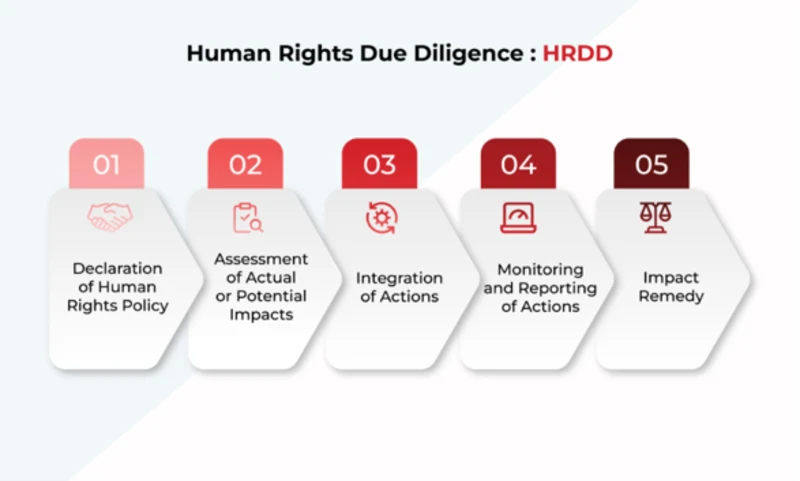
Human Rights Due Diligence : HRDD
The Company has a comprehensive human rights due diligence process, which includes assessing human rights risks to identify preventive measures and mitigate impacts from human rights risks in the Company's business operations throughout its value chain. The Company's comprehensive Human Rights Due Diligence process consists of the following 5 steps:
1. Announcement of the Company's policy and principles on respecting human rights.
The Company is committed to respecting human rights to ensure that all stakeholder groups receive fundamental rights fairly and equally. Therefore, it has announced its Human Rights Policy and published it on the Company's website for the awareness of employees and stakeholders, to serve as a guiding principle for consistent practice. In this policy, the Company strictly adheres to national and international human rights practices and principles, particularly supporting and complying with the Universal Declaration of Human Rights, the International Labour Organization's core labor conventions, and the UN Guiding Principles on Business and Human Rights.
2. Assessment of actual or potential impacts.
The Company has conducted a human rights risk assessment as part of its comprehensive human rights due diligence process. The purpose is to identify human rights risk issues and prevent human rights violations or other negative impacts that may actually occur or are likely to occur from the Company's business operations throughout its value chain, considering both internal and external stakeholders who may be directly or indirectly affected by the Company's business activities, using human rights risk assessment methods.
- Defining the scope of human rights issues.
- Risk level assessment.
The Company uses human rights issues identified from a checklist of business-related human rights risk issues to assess human rights risks, employing a Human Rights Assessment Matrix. This involves considering criteria for impact levels and likelihood levels for each human rights issue. The human rights risk levels from the assessment are divided into 5 levels: very low, low, medium, high, and very high.
- Prioritization.
The Company has prioritized significant human rights risk issues, which are issues that have severe impacts through related activities and other business relationships of the Company. For these risks, the Company will implement corrective and preventive measures to reduce the risk level.
- Monitoring and reporting performance.
The Company has established processes for reviewing, verifying, and monitoring management related to human rights violation issues according to the defined scope, risk issues, and risk indicators. Responsible departments are designated to report performance results to the Audit Committee, Risk Management Committee, and Executive Committee, as well as to inform executives and relevant departments annually. This ensures that all employees in the Company prioritize human rights risk issues and have a comprehensive and systematic risk management plan in place for incidents.
3. Integration of operations.
After the Company has identified high-risk human rights issues and obtained the results of the human rights risk assessment, the Company must address and manage these human rights risk issues. It must also consider establishing existing or potential control and mitigation measures, as well as developing additional measures, to reduce the likelihood, severity, and impact of such human rights risk issues, which may affect stakeholders. Furthermore, residual risks should be assessed after implementing human rights prevention and remediation guidelines in the Company's business operations to ensure that the Company's human rights management effectively controls impacts throughout the value chain.
4. Monitoring and reporting performance.
The Company has established processes for reviewing, verifying, and monitoring management related to human rights violation issues according to the defined scope, risk issues, and risk indicators. Responsible departments are designated to report performance results to the Audit Committee, as well as to inform executives and relevant departments, to ensure that all employees in the Company prioritize human rights risk issues and have a comprehensive and systematic risk management plan.
5. Remediation of impacts.
The Company recognizes that business activities may cause or contribute to negative impacts on the human rights of relevant stakeholders. Therefore, the Company is committed to continuously developing and implementing human rights management to plan and establish corrective and preventive measures, manage and prevent human rights violation issues, and reduce human rights risks and violations, or participate in remediation through legitimate processes. This includes providing channels for complaints or whistleblowing (Whistleblowing Policy) as specified, as well as establishing appropriate impact mitigation and remediation processes for affected stakeholders arising from or related to the Company.
Does the company have an HRDD process : Yes
Human Rights Risk Assessment
The Company has conducted a human rights risk assessment and established guidelines for action to eliminate, reduce, and prevent potential risks. This involves providing opportunities for stakeholders to participate through Employee Engagement Surveys, Supplier ESG Assessments, and the complaint channels established by the Company. The feedback from stakeholders is analyzed and used to identify significant human rights issues, as well as to improve policies, operational procedures, and related risk control measures. The results are summarized and reported to management for continuous review of human rights management approaches.
The Company has established measures for prevention and mitigation of impacts, along with monitoring and evaluating performance within the Human Rights Due Diligence framework. This ensures that the Company's core business operations respect human rights and comply with relevant international standards. The assessment results for significant human rights issues are as follows:
Root Causes of Risk
1. Customer data is disclosed without authorization.
Guidelines for Implementation:
- Establish a personal data protection policy.
- Train employees on data confidentiality.
- Utilize security systems for data storage and access.
Monitoring and Inspection Measures: Regularly inspect data security systems to detect and rectify vulnerabilities.
2. Continuous overtime work, unfair compensation.
Guidelines for Implementation: Survey and improve welfare benefits to align with employee needs and expectations.
Monitoring and Inspection Measures: Survey employee satisfaction regarding welfare and working hours at least once a year and utilize the results for improvements.
3. Applicant's personal data may be disclosed without authorization.
Guidelines for Implementation:
- Clearly define policies for the collection, use, and disclosure of applicants' personal data.
- Train employees on data confidentiality.
- Utilize security systems for data storage and access.
Monitoring and Inspection Measures: Regularly inspect data security systems to detect and rectify vulnerabilities.
Involved Risks
1. Unfair interviews and testing.
Guidelines for Implementation:
- Define clear policies and procedures for interviews and testing.
- Provide training to employees involved in interviews and testing to ensure understanding of fairness and non-discrimination principles.
Monitoring and Inspection Measures: Continuously review and improve interview and testing procedures.
2. Working conditions and environment are not conducive to work, e.g., use of harsh language, harassment.
Guidelines for Implementation: Provide complete and clear information regarding employee rights and duties.
Monitoring and Inspection Measures: Record and track complaints related to working conditions and environment.
Associated Risks
1. Unequal treatment of applicants.
Guidelines for Implementation: Establish secure and confidential reporting and complaint channels for applicants who feel they have been subjected to discrimination.
Monitoring and Inspection Measures: Survey applicant feedback after the selection process.
2. Hiring employees without providing complete information regarding rights and duties, including unfair employment contracts.
Guidelines for Implementation: Utilize questionnaires or interviews to assess the fairness of employment contracts.
Monitoring and Inspection Measures: Survey employee feedback after the hiring process to gather insights.
3. Occurrence of labor disputes between employees and customers.
Guidelines for Implementation: Encourage reporting of unfair problems or situations.
Monitoring and Inspection Measures: Survey employee feedback on the dispute resolution process to gather insights.
4. Termination of employment contracts with employees.
Guidelines for Implementation: Provide information and consultation regarding employment contract termination.
Monitoring and Inspection Measures: Record and track cases of contract termination and their resolutions.
In 2025, the Company did not identify any significant human rights violations arising from its business operations. Nevertheless, the Company consistently monitors and reviews human rights risk issues through its Human Rights Due Diligence process.
Reference link for the information and an HRDD process : https://investor.prtr.com/storage/downloads/corporate-governance/corporate-policies/20240523-prtr-hrdd-th.pdf
HRDD process diagram
Migrant Worker Management Plan and Child Labor Prevention
The Company places importance on the equal labor rights of all employees, strictly adhering to labor laws, international labor standards, and human rights practices. This includes appropriate, fair, and transparent management of migrant workers, as well as preventing the use of child labor, forced labor, and employment that does not comply with the law, in order to create a safe working environment that respects human dignity and promotes long-term sustainable business operations.
Objectives
- To protect the human rights and labor rights of all employees in accordance with universal principles, without discrimination based on nationality, race, or any other status.
- To prevent the use of child labor, forced labor, and employment that does not comply with relevant labor laws.
Goals
- No child labor, forced labor, or employment that violates labor laws throughout the operational period.
- To ensure that all employees, including migrant workers, are treated fairly, equally, and with respect for human dignity.
Guidelines and Implementation Measures
- To treat all workers equally and without discrimination, adhering strictly to human rights principles and labor laws.
- To verify qualifications and documents of job applicants before employment to comply with minimum age requirements and relevant labor laws.
- To ensure migrant workers receive fair and appropriate wages, welfare, and working conditions equivalent to general employees.
- No child labor, forced labor, or illegal labor is used, and operations that violate human rights are not supported.
- To communicate human rights and labor policies and practices to employees and relevant parties to foster mutual understanding and reduce labor risks.
Disability Employment Promotion Plan
The Company recognizes the importance of promoting equality, diversity, and non-discrimination in the workplace. It is committed to providing appropriate employment opportunities for persons with disabilities and enabling their equal participation in creating value for the organization. Therefore, the Company has developed a Disability Employment Promotion Plan to support the development of potential for persons with disabilities, create a collaborative work environment, and foster sustainable growth for the organization and society as a whole.
Objectives
- To promote equality and inclusion of persons with disabilities in the workplace.
- To provide opportunities for persons with disabilities to access employment and demonstrate their potential in a suitable manner.
Goals
- The number of employed persons with disabilities complies with the legally mandated proportion.
Guidelines and Implementation Measures
- To coordinate with relevant government and private organizations, such as the Department of Skill Development, foundations for persons with disabilities, or employment support agencies, to access potential disabled workers suitable for job positions.
- To consider, select, and allocate suitable job positions for persons with disabilities based on their abilities and limitations, enabling them to perform effectively and achieve maximum benefit for both employees and the organization.
- To facilitate throughout the employment period to ensure safety and convenience in performing duties.
- To regularly monitor, evaluate, and review the implementation of disability employment initiatives, using the results to continuously improve operational guidelines for efficiency and alignment with the company's goals.
Information on incidents related to legal or social and human rights violations
Number of cases and incidents of significant legal or social and human rights violations
| 2023 | 2024 | 2025 | |
|---|---|---|---|
| Total number of cases or incidents of significant legal or social and human rights violations cases | 0 | 0 | 0 |
| Total number of cases or incidents leading to significant labor disputes (cases) | 0 | 0 | 0 |
| Total number of incidents or complaints related to consumer rights violations (cases) | 0 | 0 | 0 |
| The total number of cases or complaints related to partner rights violations (Cases) | 0 | 0 | 0 |
| Total number of disputes with competitors (cases) | 0 | 0 | 0 |
| Total number of cases or incidents leading to disputes with the community/society (cases) | 0 | 0 | 0 |
| Total number of cases or incidents related to cybersecurity or customer data breaches (cases) | 0 | 0 | 0 |
| Total number of cases or incidents related to workplace safety and occupational health (cases) | 0 | 0 | 0 |