
Overview of the policy and guidelines
The company places importance on good corporate governance and believes that effective corporate governance is a crucial foundation for supporting the group's business operations to grow stably, transparently, and sustainably in the long term. Therefore, the company adheres to the "Principles of Good Corporate Governance for Listed Companies, Year 2560 (Corporate Governance Code: CG Code)" developed by the Securities and Exchange Commission (SEC) as the main guideline for establishing the company's policies, practices, and operations.
The company has established a written Good Corporate Governance and Business Ethics Policy, approved by the Board of Directors. This policy has been developed in accordance with national and international good corporate governance assessment criteria and recommendations from the Thai Institute of Directors Association (IOD), as well as the company's business context and characteristics. This is to support the achievement of sustainability goals, maximize shareholder value, and consider the interests of all stakeholders in a balanced manner.
The Good Corporate Governance and Business Ethics Policy applies to the company and all its subsidiaries. The company expects directors, executives, and employees at all levels to strictly adhere to and comply with it. Furthermore, the company promotes and supports business partners and associates in complying with relevant laws, regulations, and business ethics principles, as well as upholding good corporate governance principles, to collectively enhance transparency, accountability, and sustainability throughout the business value chain.
The company has stipulated that the Good Corporate Governance and Business Ethics Policy, as well as related good corporate governance policies such as the Conflict of Interest Prevention Policy, Anti-Corruption Policy, and Insider Trading Prevention Policy, shall be reviewed at least once a year to ensure suitability, modernity, and compliance with current laws, regulations, and best practices.
The company has comprehensively communicated this policy to directors, executives, and employees at all levels (100%) by requiring acknowledgment and signed confirmation of compliance, along with regular training and communication through various channels such as induction/orientation processes, Intranet system, email, and the company's website, where information is continuously updated to foster correct understanding and serve as a concrete guideline for operations.
The company continuously monitors compliance with its good corporate governance policies, covering key issues such as business ethics, prevention of conflicts of interest, insider trading, and anti-corruption. In 2025 The company found no instances of policy violations by directors, executives, or employees.
The key principles of the company's good corporate governance are divided into 8 Principles as follows:
Principle 1: Recognize the Role and Responsibilities of the Board of Directors as Organizational Leaders Who Create Sustainable Value for the Business
Principle 2: Define the Company's Main Objectives and Goals for Sustainability
Principle 3: Strengthen an Effective Board of Directors
Principle 4: Recruit and Develop Senior Executives and Manage Personnel
Principle 5: Promote Innovation and Responsible Business Operations
Principle 6: Appropriate Risk Management and Internal Control Systems
Principle 7: Maintain Financial Credibility and Information Disclosure
Principle 8: Ensure Engagement and Communication with Shareholders
Reference link for the full version of corporate governance policy and guidelines : https://investor.prtr.com/storage/content/corporate-governance/cg-policy/prtr-cg-policy-th.pdf
Policy and guidelines related to the board of directors
Nomination of directors
The Board of Directors oversees that the recruitment and selection of directors follow a transparent, clear, and verifiable process to ensure that qualified directors are obtained, suitable for the size, type, and complexity of the business, and consistent with the business strategy and the established composition of the Board of Directors. Key practices are as follows:
- The Board of Directors has appointed the Corporate Governance, Sustainable Development, Nomination, and Remuneration Committee to recruit qualified individuals, propose opinions to the Board of Directors, or propose to the shareholders' meeting for consideration of appointment as directors (as the case may be). The Board of Directors or shareholders will receive sufficient information about the nominated individuals to aid in their decision-making.
- The Corporate Governance Committee will consider the criteria and methods for director recruitment, taking into account the structure of the Board of Directors to ensure an appropriate number of directors for the company's size and business strategy, as well as diversity in the composition of the Board (Board Diversity), including but not limited to ethnicity, religion, culture, origin, age, and gender, along with the suitability of qualifications, skills, and expertise necessary for the Board of Directors. A Board Skill Matrix will be developed to serve as a framework for defining the qualifications of desired directors.
In the year 2025 No independent director of the company has served for more than 9 years, and in the past year, no independent director of the company has served for more than 9 years, which reflects that the company manages director terms appropriately and in line with good corporate governance principles.
Currently, the Board of Directors comprises qualified individuals with diverse knowledge, abilities, and experience, who can apply their expertise to set the company's policies and operational direction for the utmost benefit of the company's business. The Board maintains its independence in decision-making for the best interests of the company and its shareholders, and also oversees, monitors, inspects, and evaluates the performance of the management to align with established goals.
The company has a total of 9 members, comprising executive directors, non-executive directors, and independent directors numbering 3 members, which constitutes one-third of the total number of directors, thereby creating an appropriate balance and check-and-balance in the company's management.
Determination of director remuneration
The Shareholders' Meeting has the authority to consider and approve the structure and rates of remuneration for the Company's directors. When proposing director remuneration to the Shareholders' Meeting, the Board of Directors has assigned the Corporate Governance, Sustainable Development, Nomination, and Remuneration Committee to review and screen the proposal to ensure that the remuneration structure and rates are appropriate for the duties, responsibilities, and roles of each director.
The determination of such remuneration aims to ensure fairness and appropriateness, effectively incentivize the Board of Directors to perform their duties efficiently, and support the organization in achieving its operational goals both in the short and long term sustainably.
Independence of the board of directors from the management
The Company has a management structure that stipulates the segregation of powers, duties, and responsibilities between the Board of Directors. Sub-committees and management clearly. The scope of authority and duties is stipulated in writing in the Board Charter and the charters of each sub-committee, and disclosed to the public, serving as a mechanism for checks and balances, enhancing transparency, and improving the efficiency of corporate governance.
The Board of Directors is responsible for defining the Company's vision, mission, values, strategies, and long-term goals, as well as overseeing, monitoring, and evaluating the performance of the management to ensure compliance with established policies and directions. Meanwhile, the management is responsible for efficiently conducting daily operations, achieving results in line with the Company's policies, vision, mission, values, strategies, and goals, and regularly reporting operational results to the Board of Directors.
Director development
The Board of Directors oversees that all directors possess knowledge and understanding of their roles, duties, and responsibilities, the company's business characteristics, relevant laws and regulations, risk standards, and supports directors in continuously enhancing the necessary skills and knowledge for performing their duties. This is achieved by assigning the Corporate Governance, Sustainable Development, Nomination, and Remuneration Committee to develop a director development plan to appropriately and continuously enhance the potential of current and new directors, ensuring their understanding of the company's business, the roles and duties of directors, and significant developments.
Board performance evaluation
The Company mandates the evaluation of the performance of the Board of Directors, both in the form of collective and individual evaluations, including the evaluation of the performance of sub-committees, once a year. The evaluation results will be used as a guideline for reviewing performance, identifying problems and obstacles in operations during the past year, as well as a guideline for developing, correcting, and improving work efficiency in performing duties. Furthermore, the suitability of the composition of the Board of Directors and sub-committees will be continuously evaluated and developed.
Succession Plan (Succession Plan)
The company has developed a succession plan (Succession Plan) for the positions of Chief Executive Officer, senior management, and executives in critical roles, which is part of the company's human resource planning strategy to ensure readiness in organizational management in cases where executives are unable to perform their duties or complete their terms. This is to ensure the continuous and efficient operation of the company and its subsidiaries.
Corporate governance structure and significant information related to the board of directors, subcommittees, executives, employees, and others
Corporate governance structure
As of December 31, 2025, the Company has a corporate governance structure comprising the Board of Directors, which operates within the scope of laws, objectives, the Company's articles of association, and resolutions of shareholders' meetings. The Board of Directors has established three sub-committees: the Corporate Governance, Sustainable Development, Nomination, and Remuneration Committee; the Audit and Risk Management Committee; and the Executive Committee. The Chief Executive Officer serves as the Company's highest executive, managing operations under various departments.
Corporate governance structure diagram
Corporate governance structure as of date : 31 December 2025
Corporate governance structure diagram
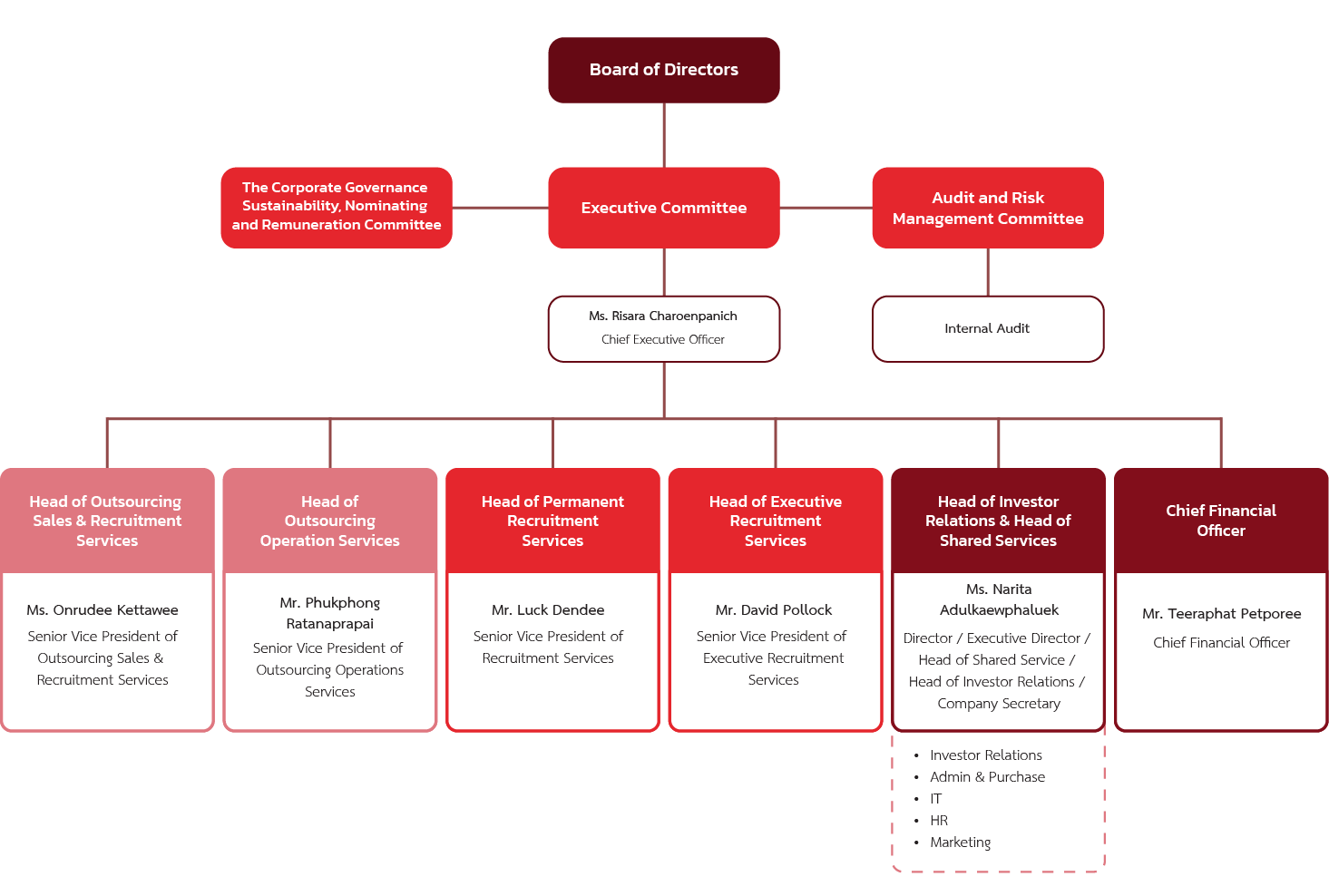
Corporate Governance Structure
Information on the board of directors
The structure of the board of directors comprises a number of directors appropriate to the company's size and business strategy. There must be no fewer than 5 directors, and at least half of the total number of directors must reside in the Kingdom. Furthermore, the board of directors must include independent directors in a proportion of no less than one-third of the total number of directors. all, and must be no less than 3 persons. Independent directors must possess qualifications in accordance with the criteria stipulated by the Securities and Exchange Commission.
The Company has established a board structure policy that emphasizes diversity of qualifications, encompassing professional skills, experience, capabilities, characteristics, specialized expertise, as well as diversity in gender, age, race, and nationality, to support the achievement of the organization's strategic objectives and goals. The Company has defined and conducted an assessment of the diversity of skills, knowledge, and expertise of the board of directors (Board Skills Matrix) and reviewed at least once a year to ensure that the board of directors as a whole possesses appropriate qualifications, can oversee the business, and effectively understand and respond to the needs of stakeholders.
Furthermore, the Company recognizes the important role and contribution of women on the board of directors and promotes the recruitment of female individuals to serve as directors, stipulating that there must be at least 1 person
As of December 31, 2025, the Company has a total of 9 directors, of whom 3 are independent directors who fully meet the criteria stipulated by the Securities and Exchange Commission. This also includes 3 female directors, demonstrating an appropriate level of gender diversity.
The board of directors exhibits diversity in multiple dimensions, including gender, nationality, race, age, educational background, work experience, skills, and knowledge relevant to the company's business. The board has reviewed the Board Skills Matrix (Board Skills Matrix) annually, and also arranges for the assessment of each director's knowledge and expertise.
The evaluation results indicate that all directors possess knowledge, abilities, and specialized expertise consistent with the company's business nature, which is reflected through Board Skills Matrix and supports effective, transparent, and good corporate governance.
Composition of the board of directors
| Number (persons) | Percent (%) | |
|---|---|---|
| Total directors | 9 | 100.00 |
| Male directors | 6 | 66.67 |
| Female directors | 3 | 33.33 |
| Executive directors | 5 | 55.56 |
| Non-executive directors | 4 | 44.44 |
| Independent directors | 3 | 33.33 |
| Non-executive directors who have no position in independent directors | 1 | 11.11 |
Diagram of the board of directors
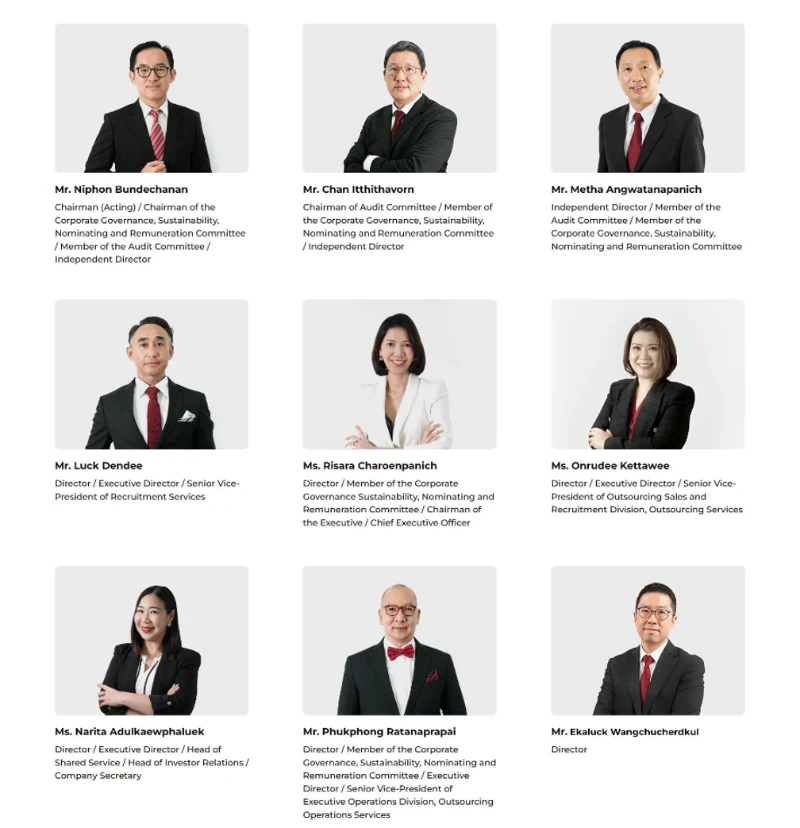
List of the board of directors by position
| List of the board of directors | Position | Executive directors | Non-executive directors | Independent directors | Non-executive directors who have no position in independent directors | Authorized directors as per the company’s certificate of registration |
|---|---|---|---|---|---|---|
| 1. Mr. Niphon Bundechanan | Chairman of the board of directors | ✓ | ✓ | |||
| 2. Mr. Luck Dendee | Director | ✓ | ✓ | |||
| 3. Ms. Risara Charoenpanich | Director | ✓ | ✓ | |||
| 4. Ms. Onrudee Kettawee | Director | ✓ | ✓ | |||
| 5. Mr. Chan Itthithavorn | Director | ✓ | ✓ | |||
| 6. Mr. Phukphong Ratanaprapai | Director | ✓ | ✓ | |||
| 7. Ms. Narita Adulkaewphaluek | Director | ✓ | ||||
| 8. Mr. Metha Angwattanapanich | Director | ✓ | ✓ | |||
| 9. Mr. Ekaluck Wangchucherdkul | Director | ✓ | ✓ | |||
| Total (persons) | 5 | 4 | 3 | 1 | 4 |
Overview of director skills and expertise
| Skills and expertise | Number (persons) | Percent (%) |
|---|---|---|
| 1. Economics | 1 | 11.11 |
| 2. Finance & Securities | 1 | 11.11 |
| 3. Law | 1 | 11.11 |
| 4. Marketing | 3 | 33.33 |
| 5. Accounting | 2 | 22.22 |
| 6. Finance | 2 | 22.22 |
| 7. Human Resource Management | 4 | 44.44 |
| 8. Sustainability | 1 | 11.11 |
| 9. IT Management | 2 | 22.22 |
| 10. Data Management | 1 | 11.11 |
| 11. Corporate Management | 3 | 33.33 |
| 12. Engineering | 1 | 11.11 |
| 13. Leadership | 3 | 33.33 |
| 14. Strategic Management | 6 | 66.67 |
| 15. Risk Management | 2 | 22.22 |
| 16. Internal Control | 3 | 33.33 |
| 17. Budgeting | 1 | 11.11 |
| 18. Governance/ Compliance | 1 | 11.11 |
| 19. Business Administration | 7 | 77.78 |
Knowledge, Expertise, or Specialized Experience Relevant to the Company’s Business
Board Diversity
The Board of Directors has established a Board Diversity Policy (Board Diversity Policy) emphasizing diversity in terms of gender, age, skills, experience, and expertise in areas essential for good corporate governance. The company utilizes the Board Performance Evaluation Framework (Skill Matrix) To ensure that the Board of Directors comprises individuals with comprehensive knowledge, capabilities, and experience in key areas such as data management, organizational management, human resource management, economics, accounting, finance, general management, and business administration, etc.
All non-executive directors of the company possess relevant work experience in the company's business and a thorough understanding of the industry in which the company operates. This contributes to effective, transparent governance and strategic decision-making, in line with good corporate governance principles.
Furthermore, the Board of Directors emphasizes promoting gender diversity within the board structure, recognizing that gender diversity enhances comprehensive perspectives, supports strategic decision-making, and strengthens sustainable good corporate governance.
Currently, the company has a proportion of female directors accounting for 33% of the total number of directors, and the Board of Directors is committed to maintaining this proportion of female directors in the future and considering increasing the proportion of female directors when appropriate opportunities arise. This will be reviewed annually through the consideration of director nominations and appointments, and will be carried out based on qualifications, knowledge, capabilities, and suitability for the company's business, without gender discrimination.
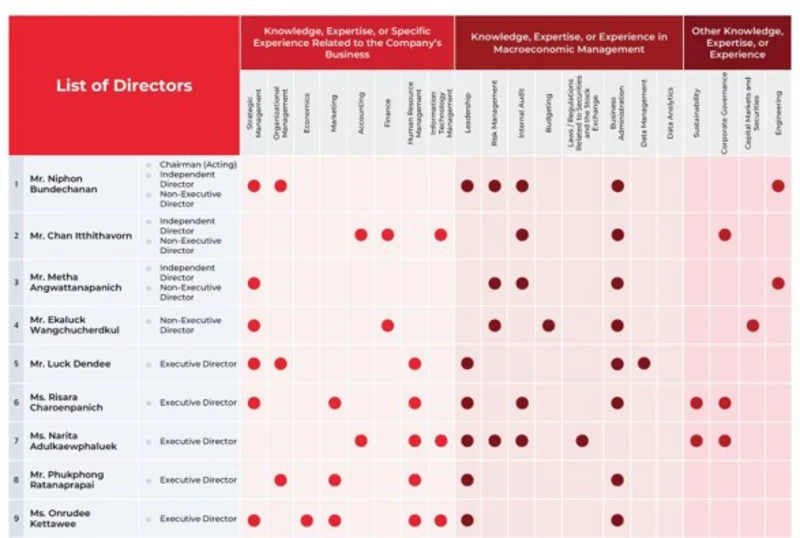
Board Skill Matrix
Information about the other directors
The chairman of the board and the highest-ranking executive are from the same person : No
The chairman of the board is an independent director : Yes
The chairman of the board and the highest-ranking executive are from the same family : No
Chairman is a member of the executive board or taskforce : No
The company appoints at least one independent director to determine the agenda of the board of directors’ meeting : Yes
The measures for balancing the power between the board of directors and the Management
The measures for balancing the power between the board of directors and the Management : Yes
Methods of balancing power between the board of directors and Management : Appointing an independent director to jointly consider the agenda of the board of directors’ meeting
Board Diversity : Board Diversity Targets
| Key Performance Indicators (KPIs) / Performance | 2024 | 2025 | 2026 | 2027 | 2028 |
|---|---|---|---|---|---|
| Historical Performance | |||||
| Total Number of Board Members (Persons) | 9 | 9 | - | - | - |
| Number of Female Board Members (Persons) | 3 | 3 | - | - | - |
| Proportion of Female Board Members (%) | 33.33% | 33.33% | - | - | - |
| Targets | |||||
| Female Board Representation Target | - | - | ≥ 30.00% | ≥ 30.00% | ≥ 30.00% |
| Formalized Board Diversity Policy | Implemented | Implemented | Annual Review | Annual Review | Annual Review |
| Gender Non-Discrimination Policy | Implemented | Implemented | Enforced | Enforced | Enforced |
| Board Skill Matrix Assessment | Implemented | Implemented | Annual Review | Annual Review | Annual Review |
Note: The Board of Directors is committed to maintaining the proportion of female directors and has set a clear target for 2026–2028 (B.E. 2569–2571) to enhance sustainable corporate governance.
Business code of conduct
The Company recognizes the equal rights of all stakeholder groups and prioritizes conducting business in accordance with good corporate governance principles. Therefore, the Board of Directors has established Business Ethics Code of Conduct towards Stakeholders, and ethical and business conduct guidelines to serve as a framework for the operations of directors, executives, and employees at all levels. This is considered a shared duty and responsibility to ensure that business operations are conducted with honesty, integrity, transparency, accountability, and fairness towards all stakeholders. which will lead to building trust and sustainable long-term growth for the Company.
The Company has mandated an annual review of its business ethics and related guidelines to ensure they are appropriate, up-to-date, and consistent with relevant laws, regulations, good practices under good corporate governance principles, and changes in the business context.
In addition, the Company has communicated, disseminated, and provided comprehensive training to directors, executives, and employees at all levels regarding business ethics. 100% consistently through various channels such as orientation/induction processes, the Intranet system, and the Company's website, where information is continuously updated to ensure that personnel at all levels can adhere to and implement it correctly, clearly, and concretely.
In the year 2025, the Company strictly monitored, audited, and evaluated compliance with the organizational code of conduct. No cases of ethical misconduct or violations of the organizational code of conduct were found from directors, executives, or employees at any level, reflecting the effectiveness of ethical management, transparency, and a positive organizational culture.
Principles of Business Conduct based on Ethics
Principle 1: Integrity
The Company believes that conducting business with honesty, integrity, and fairness towards all stakeholder groups, including customers, business partners, debtors, creditors, job applicants (Candidates), and other relevant parties, will build long-term trust, credibility, and confidence in the Company. Directors, executives, and all employees must uphold integrity as a key principle in decision-making and operations.
Principle 2: Compliance with Laws and Regulations
The Company conducts its business strictly within the framework of laws, regulations, and requirements of relevant government agencies and regulatory bodies. It establishes effective internal control and audit systems to ensure that operations comply with applicable standards and laws.
Principle 3: Confidentiality and Data Protection
The Company respects the rights of data owners and prioritizes the protection of personal data and confidential information of the Company, customers, business partners, employees, and stakeholders. Such information will be appropriately stored, and not improperly disclosed, used, or transferred, unless required by law or with proper consent.
Principle 4: Competency & Responsibility
The Company recognizes the importance of appropriate knowledge, abilities, skills, and experience in the performance of duties by directors, executives, and employees at all levels, enabling them to perform their duties efficiently, professionally, and in accordance with their assigned responsibilities. The Company supports continuous development of knowledge and skills to enhance the quality of operations and meet the expectations of stakeholders.
Policy and guidelines related to business code of conduct : https://investor.prtr.com/storage/content/corporate-governance/code-of-conduct/prtr-code-of-conduct-and-business-ethics-of-the-company-th.pdf
Policy and guidelines related to business code of conduct
Guidelines related to business code of conduct : Prevention of conflicts of interest, Anti-corruption, Whistleblowing and Protection of Whistleblowers, Preventing the misuse of inside information, Money laundering prevention, Gift giving or receiving, entertainment, or business hospitality, Compliance with laws, regulations, and rules, Information and assets usage and protection, Anti-unfair competitiveness, Information and IT system security, Environmental management, Human rights, Safety and occupational health at work, Other guidelines related to business code of conduct
Prevention of conflicts of interest
The Company places importance on preventing conflicts of interest to ensure that business operations are transparent, fair, and primarily focused on the best interests of the group of companies. "Conflict of interest" refers to a situation where personal interests or external interests, whether financial interests, personal relationships, or any other interests, may affect the exercise of discretion or decision-making in performing duties and lead to unfairness to the Company.
The Company requires directors, executives, and employees at all levels to perform their duties with honesty, integrity, and responsibility towards the Company, prioritizing the Company's interests and avoiding any actions that may lead to conflicts of interest. This includes prohibiting the use of authority, influence, or responsible status to seek personal gain or benefit for associates, whether directly or indirectly.
The Board of Directors requires directors of the Company, its subsidiaries, and executives to report their own interests and those of related persons, in accordance with Section 89/14 of the Securities and Exchange Act B.E. 1992 by requiring reports upon initial appointment and/or when there are changes in information to the Company Secretary, in compliance with Securities and Exchange Act B.E. 1992 to effectively use such information for verification and prevention of conflicts of interest.
Furthermore, the Company's personnel must not engage in businesses that are competitive or may create conflicts of interest with the group of companies, and must not use inside information, duties, or authority obtained from the Company to seek personal gain. This also includes not holding external positions that may affect independence or work efficiency, unless written approval is obtained from their supervisor as stipulated by the Company.
Should a situation arise that may lead to a conflict of interest, the Company requires full and transparent disclosure of information and independent consideration for resolution, under business ethics and good corporate governance principles, prioritizing the interests of the Company and its stakeholders.
Related party transactions
In cases where related party transactions are necessary, the Company stipulates that such transactions must adhere to general commercial terms, under criteria approved by the Board of Directors with transparency and fairness, as if conducting business with external parties, prioritizing the Company's best interests. Furthermore, individuals with a vested interest must strictly abstain from participating in the consideration and voting on transactions in which they are involved.
For significant related party transactions or transactions not in line with general commercial terms, the Company requires review and approval from the Audit and Risk Management Committee before seeking approval from the Board of Directors or the Shareholders' Meeting. The Company adheres to relevant laws, rules, and regulations, and discloses important information transparently, accurately, and up-to-date as required by law.
Monitoring and Performance Results
In the year 2025, The Company continuously monitors and supervises the prevention of conflicts of interest, with key actions as follows:
- All directors and executives have prepared reports on their own interests in accordance with the criteria set by the Company.
- In considering related party transactions or transactions that may lead to conflicts of interest, the Company conducts them as if they were transactions with general third parties, under fair commercial terms and free from the influence of official positions.
- Directors, executives, or individuals with a vested interest in such transactions shall not participate in the approval process for those transactions, and reports are submitted to the Audit Committee for consideration and opinion every quarter.
- Related party transactions in 2025 are business necessities, with clear and transparent approval processes, and generate maximum benefit for the Company.
Throughout the past year until now, the Company No complaints or violations of the conflict of interest management policy were found. of directors and executives
Communication and Training
Over the past year, the Company has communicated, disseminated, and organized training to build comprehensive knowledge and understanding of the conflict of interest prevention policy for directors, executives, and employees at all levels (100%) and continuously, through various channels, including training for directors, executives, and new employees via orientation (Orientation/Induction)
Additionally, the Company promotes and develops knowledge regarding relevant rules, policies, and practices through the system Intranet and the internal organizational website, which is regularly updated. Furthermore, the Company disseminates and informs employees of important information through various channels, including email (E-mail) application Line and internal communication media, to enable personnel at all levels to correctly, clearly, and concretely adhere to and implement the policy.
Reference link for prevention of conflicts of interest : https://investor.prtr.com/storage/downloads/corporate-governance/corporate-policies/prtr-conflict-of-interest-policy-th.pdf
Anti-corruption
The company is committed to conducting business in accordance with good corporate governance principles and business ethics for the maximum benefit of shareholders and all stakeholders. The company has established Anti-Corruption Policy to ensure strict adherence and practice by directors, executives, and employees. The company reviews this policy annually, and in the year 2025 The Board of Directors reviewed the policy at meeting no. 5/2025 On 10 November 2025
Corruption refers to the unlawful pursuit of benefits for oneself or others in all forms, both direct and indirect, including giving or receiving bribes, political assistance, donations, financial support, gifts, entertainment expenses, or any other expenses, especially the misuse of authority, which causes injustice and damage to the company, the economy, and society.
The group of companies has a clear intention not to tolerate any form of corruption and has no policy to penalize or take negative action against personnel who refuse corruption, even if such refusal results in the company losing business opportunities.
Directors, executives, employees, and individuals involved in the company's business operations must strictly adhere to the Anti-Corruption Policy and must not participate in any form of corruption. Emphasis is placed on transparency, integrity, and compliance with laws when conducting transactions with business partners, government agencies, and all stakeholders. Further details can be found in the Anti-Corruption Measures and Whistleblowing Channel on the company's website, as well as the guidelines specified in the Intranet system.
Monitoring and Performance Results
The company places importance on continuously monitoring compliance with the Anti-Corruption Policy by regularly tracking and evaluating anti-corruption risk management to ensure that internal control measures are adequate, appropriate, and consistent with the company's business operations.
In the year In 2025, the company strictly adhered to the Anti-Corruption Policy, with no instances of policy violations found and no incidents of fraud reported from directors, executives, or employees of the company. Furthermore, there were no cases of non-executive directors resigning due to issues related to corporate governance.
In 2025, the company strictly adhered to the Anti-Corruption Policy, with no instances of policy violations found and no incidents of corruption (Fraud) from directors, executives, or employees of the company. Furthermore, no non-executive directors resigned due to issues related to the company's corporate governance.
The company also emphasizes fostering an organizational culture committed to integrity and transparency through various supporting measures, including:
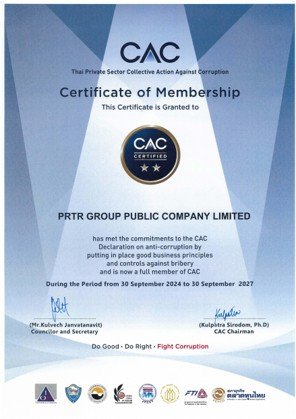
- Participation in the Collective Action Against Corruption (CAC) project of the Thai private sector to elevate corporate governance standards and strengthen internal control systems.
- Promoting a "No Gift Policy" culture within the organization and among all stakeholders.
- Campaigning and encouraging business partners and allies to adhere to anti-corruption principles, including supporting partners to join the CAC project to collectively raise standards in the value chain.
The company will continue to develop and improve its governance and internal control measures to foster transparency and build confidence among all stakeholder groups.
Communication and Training
The company has communicated and disseminated the Anti-Corruption Policy to directors, executives, and employees at all levels through various channels, such as the company's website, the system Intranet and internal organizational documents, with information updated regularly.
Additionally, the company has continuously organized training to enhance knowledge and understanding of the Anti-Corruption Policy for employees at all levels, incorporating it as part of the orientation process (Orientation / Induction) and refresher training for current employees through the PRTR Compliance Essentials: PDPA, Anti-Corruption & IT Security course for the year
Over the past year, the company has communicated, disseminated, and organized training to build knowledge and understanding regarding Anti-Corruption Policy to directors, executives, and employees at all levels completely (100%) and continuously, through various channels, including training for directors, executives, as well as new employees through orientation (Orientation/Induction)
Additionally, the company has promoted and developed knowledge regarding relevant rules, policies, and practices through the system Intranet and internal organizational websites, which are regularly updated. Additionally, the company disseminates important information to employees through various channels, including email (E-mail) application Line and internal communication media, in order to reflecting the company's commitment to raising awareness and encouraging personnel to understand and correctly, clearly, and concretely implement the policy in their operations.
All employees of the Company, including persons involved in the Company’s business operations, are required to strictly comply with the Company’s Anti-Corruption Policy. They must not engage in any form of corruption, whether directly or indirectly. The Company places great importance on transparency and integrity in conducting transactions with business partners, officers, employees, and relevant authorities in order to avoid any actions that may lead to improper conduct, conflict with the Company’s Anti-Corruption Policy, or violate applicable anti-corruption laws. For further details, please refer to the Anti-Corruption Measures available on the Company’s website at https://investor.prtr.com/th/corporate-governance/whistleblowing-channel , as well as the Fraud Risk Management Policy and related guidelines and procedures available on the Company’s Intranet system.
Reference link for anti-corruption : https://investor.prtr.com/storage/downloads/corporate-governance/corporate-policies/prtr-anti-corruption-policy-th.pdf
Whistleblowing and Protection of Whistleblowers
The Company is committed to conducting business based on good corporate governance principles, with a clear anti-corruption policy, and adheres strictly to its business ethics. Therefore, it has established a Whistleblowing and Complaint Policy to serve as a channel for reporting cases of corruption, rights violations, or actions that violate laws, regulations, rules, or the Company's business ethics, from all employees and stakeholders.
The Company has a mechanism for protecting whistleblowers (Whistleblower Protection) and places importance on keeping complaint information confidential to build trust among complainants. The Company has assigned the Audit and Risk Management Committee to oversee and establish guidelines for managing complaints or whistleblower information received through the designated channels.
Procedure for Managing Whistleblowing and Complaints Regarding Corruption and Business Ethics Violations
- Upon receiving a report, the Audit and Risk Management Committee will consider appointing an investigation committee to collect evidence, verify facts, and conduct an inquiry into the reported issues, as well as recommend approaches for managing and resolving complaints. All operations must be transparent, fair, and auditable.
- Upon completion of the investigation, the investigation committee will summarize the findings and prepare a report for submission to the Audit and Risk Management Committee. If the complaint causes or may cause significant damage, the Company will report it without delay and propose appropriate corrective actions.
- If no wrongdoing is found, the case will be summarized and closed. However, if wrongdoing is found, the Company will consider imposing penalties according to relevant regulations, report to the Audit and Risk Management Committee, which consists of independent directors, and establish preventive measures to avoid recurrence.
Whistleblowing and Complaint Channels
(In cases of corruption, business ethics violations, or human rights violations)
Channel 1
Report whistleblowing and complaints directly to the Chairman of the Audit and Risk Management Committee via the Company's website.
Website: https://www.prtr.com
Channel 2
Electronic Mail (E-mail) To the Chairman of the Audit and Risk Management Committee
E-mail: whistle-blowing@prtr.com
Channel 3
By Post To the Chairman of the Audit and Risk Management Committee
PRTR Group Public Company Limited
2034/82 Italthai Tower, 18th Floor New Petchburi Road, Bang Kapi Subdistrict, Huai Khwang District Bangkok 10320
Monitoring and Performance Results
In the year In 2025, the Company rigorously monitored corruption and business ethics violations across all stages, including continuously reviewing whistleblowing and corruption-related complaints. The results are reported to the Audit Committee and the Risk Management Committee, which comprise independent directors, on a quarterly basis.
From the aforementioned monitoring process, no complaints or cases of corruption or ethical violations involving directors, executives, or employees of the Company were found, which aligns with the Company's goal of operating transparently and with good governance.
Reference link for whistleblowing and protection of whistleblowers : https://investor.prtr.com/storage/downloads/corporate-governance/corporate-policies/prtr-whistleblowing-and-complaint-policy-th.pdf
Preventing the misuse of inside information
The Group recognizes the importance of preventing the use of inside information for personal gain or for the benefit of others. The use of inside information in securities trading is considered an illegal act under the Securities and Exchange Act B.E. 2535 (1992).
Inside information refers to information that has not yet been disclosed to the public and may affect the price of securities or investment decisions. Directors, executives, and employees of the Group, as well as related persons, must strictly adhere to the policy on preventing the use of inside information. They must not use, disclose, or transmit inside information for their own benefit or the benefit of others, whether directly or indirectly, and must ensure that related persons, such as spouses and minor children, do not violate this policy.
The company has established an insider trading policy with the following key provisions:
- Must maintain the confidentiality of the company's secrets and inside information.
- Prohibition of using or disclosing inside information for personal gain or for the benefit of others.
- Prohibition of buying, selling, transferring, or receiving transfers of company securities using inside information, or engaging in any act that may cause damage to the company.
- Do not buy or sell company securities during the period 1 month prior to the date the company submits its financial statements to the Securities and Exchange Commission and the Stock Exchange of Thailand, until within 24 hours from the date such financial statements are disclosed to the public (Blackout Period).
- In cases where there is internal information that has not yet been disclosed to the public and may affect the company's stock price, individuals who become aware of such information are prohibited from buying or selling the company's securities until the period has passed. 24 hours from the date such information has been disclosed to the public.
- Individuals designated by the company who wish to buy or sell company securities must notify the Board of Directors or its assigned representative, such as the Company Secretary, at least 1 business day prior to the transaction, and must notify their intention using the form and through the channels specified by the company.
Furthermore, all directors and executives are aware of their duty to report changes in securities holdings, including those of their spouses and minor children, to the company, as well as to the Securities and Exchange Commission and the Company Secretary within 3 business days from the date of change, in accordance with Section 59 of the Securities and Exchange Act B.E. 2535 (1992).
Monitoring and Performance
In the year 2025, the company has fully complied with good corporate governance principles. The Company Secretary has consistently informed directors, executives, and relevant employees in writing about the regulations, the blackout period for securities trading, and the duty to report securities holdings, as well as regularly reporting such information to the Board of Directors.
Furthermore, in the year 2025, the Company Secretary's Office will notify relevant individuals via email about the Blackout Period in advance. No cases of directors or executives violating the insider trading policy were found, and the company has not received any complaints regarding the misuse of inside information.
Communication and Training
Over the past year, the company has communicated, disseminated, and organized training sessions to build knowledge and understanding of the policy on preventing the use of inside information for personal gain among directors, executives, and employees at all levels comprehensively ( 100%) and continuously, through various channels, including training for directors, executives, as well as new employees via orientation (Orientation/Induction)
Additionally, the company has promoted and developed knowledge regarding relevant rules, policies, and practices through the system Intranet and the internal corporate website, which is regularly updated. Additionally, the company disseminates important information to employees through various channels, including email ( E-mail) Application Line and internal communication media, to ensure that personnel at all levels can adhere to and implement the policy correctly, clearly, and concretely.
Reference link for misuse of inside information : https://investor.prtr.com/storage/downloads/corporate-governance/corporate-policies/prtr-insider-information-policy-th.pdf
Money laundering prevention
The Group places importance on and strictly adheres to the laws on anti-money laundering to ensure that business operations are transparent, lawful, and to prevent the Group from being used as a channel or tool for money laundering in any form.
Money laundering refers to any act aimed at transferring, concealing, or disguising the origin of assets obtained unlawfully to make such assets appear as if they were derived from legitimate business operations or activities.
Directors, executives, and employees of the Group must strictly comply with anti-money laundering guidelines. They must exercise caution in conducting business, selecting business partners, and verifying the background, credibility, and nature of business operations of partners to ensure that transactions are conducted honestly, transparently, and do not constitute money laundering or support money laundering.
Monitoring and Performance Results
The company mandates continuous monitoring of compliance with anti-money laundering measures by integrating money laundering risk management into internal control processes and business operations to ensure that operations are transparent and in compliance with relevant laws.
In the year 2025, the company has strictly implemented anti-money laundering measures. No cases of transactions suspected of money laundering or policy violations by the company's directors, executives, and employees were found.
Reference link for money laundering prevention : https://investor.prtr.com/storage/downloads/corporate-governance/corporate-policies/prtr-anti-money-laundering-th.pdf
Gift giving or receiving, entertainment, or business hospitality
The company has established guidelines for giving or receiving gifts, souvenirs, entertainment, or business hospitality to prevent corruption, conflicts of interest, and to ensure business operations are transparent, fair, and in line with business ethics. The guidelines are as follows:
Giving or receiving gifts, souvenirs, or other benefits.
- Do not accept, give, or solicit gifts, souvenirs, or any other benefits in the form of cash, checks, bonds, shares, gold, jewelry, real estate, or similar assets from individuals or entities involved in coordination with both public and private sectors, in order to obtain undue benefits.
However, customary gift-receiving is permissible, provided the value does not exceed 3,000 Baht per person per occasion.
- Do not accept, give, or solicit assets, goods, gifts, presents, or any other benefits that may induce dereliction of duty or influence inappropriate decision-making.
However, customary gift-giving is permissible, provided the value does not exceed 5,000 Baht per person per occasion. - Do not accept, give, or solicit assets, goods, gifts, or any other benefits to influence decisions or lead to inappropriate, unfair, or biased conduct. Hospitality must not exceed 3,000 Baht per person per occasion.
- Do not act as an intermediary in offering money, assets, goods, or any other benefits to individuals or entities involved in business, government agencies, or any organizations in exchange for undue privileges, or to induce non-compliance with relevant laws, regulations, or rules.
Exception: Do not accept or give cash in any circumstances.
- The giving or receiving of gifts or presents during traditional festivals, such as New Year, or for congratulatory occasions, is permissible within an appropriate value, in accordance with company regulations, provided that:
- Giving gifts must not exceed 5,000 Baht per person per occasion.
- Receiving gifts must not exceed 3,000 Baht per person per occasion.
- Giving or receiving business hospitality.
The giving or receiving of business hospitality, including hospitality services and other expenses related to business operations (Hospitality, Entertainment and Expense), must adhere to the following guidelines:
- The giving of business hospitality must have a clear business objective, be verifiable with evidence, and strictly follow the company's procedures and regulations.
- Acceptance of business hospitality must have a clear business objective, be in accordance with appropriate customary practices, and must not be a channel or tool for corruption.
- Hospitality must not exceed 3,000 Baht per person per occasion.
Furthermore, the giving or receiving of business hospitality must strictly adhere to the company's established guidelines and procedures regarding spending, hospitality, and other expenses.
Reference link for gift giving or receiving, entertainment, or business hospitality : https://investor.prtr.com/storage/downloads/corporate-governance/corporate-policies/prtr-anti-corruption-policy-th.pdf
Compliance with laws, regulations, and rules
- Operate in compliance with laws, governmental requirements, and relevant regulatory bodies, such as the Securities and Exchange Act, the Public Limited Company Act, regulations of the Stock Exchange of Thailand, the Securities and Exchange Commission (SEC), as well as other laws, regulations, and rules related to the company's business operations.
- Avoid corruption, including giving or receiving gifts, hospitality, or any benefits from customers, partners, or parties involved with the company's business that could lead to corruption, unless it is a legitimate business operation or in accordance with appropriate customary values during festivals and traditions, as per the company's rules and regulations.
- Refrain from engaging in, cooperating with, assisting, promoting, or supporting any activities, transactions, or operations that appear to be unlawful or contrary to laws, regulations, and business ethics.
- Act with political neutrality, refraining from showing allegiance to or supporting any political group or party, and aiming to foster sustainable growth that benefits society, communities, and environmental conservation.
- The Company regularly monitors compliance with laws, regulations, and rules, including tracking and evaluating operational performance, to ensure that business operations are conducted correctly, transparently, and in accordance with good corporate governance principles.
- The Company emphasizes communication and training to build knowledge, understanding, and awareness among directors, executives, and employees regarding relevant laws, regulations, ethics, and practices, enabling them to perform their duties correctly and in accordance with the policies of The Company
Information and assets usage and protection
The company recognizes the importance of using and preserving company information and assets to maximize organizational benefits, prevent loss, damage, or inappropriate use. All directors, executives, and employees have a duty and responsibility to properly care for and use company information and assets, and must strictly comply with relevant policies, regulations, and guidelines.
- Use and Preservation of Company Information
- Use company information with caution and protect confidential information from leakage, loss, or unauthorized use.
- Store and use the company's internal information, such as financial data, strategic plans, business information, customer lists, or any other data that may affect the company, securely and according to appropriate access levels.
- Do not disclose, transfer, or provide confidential company information to external parties or unauthorized individuals, unless permitted by authorized personnel according to company regulations.
- Strictly comply with laws and policies related to personal data protection, and do not use customer, employee, or business partner data without consent as required by law.
- Use and Preservation of Company Assets
- Use company assets such as office equipment, computers, network systems, software, information systems, and intellectual property solely for the benefit of the company's business operations, and not for personal gain or illegal purposes.
- Care for, maintain, and use company assets with caution, without negligence, and minimize potential damage or loss.
- Do not use, disseminate, or disclose company proprietary assets or information without authorization.
- Use the company's email, internet, and information technology systems appropriately, and comply with cybersecurity policies to prevent technological risks and threats.
Anti-unfair competitiveness
The company conducts its business with integrity, professionalism, and adherence to the principles of free and fair competition, strictly complying with domestic and international trade competition laws, as well as its Corporate Governance Policy and Code of Business Conduct, to build trust among all stakeholders.
Guidelines
- Treat trade competitors fairly, honestly, and transparently within the framework of laws and business ethics.
- Do not commit any act that violates or may be deemed to violate trade competition laws, such as price collusion, market allocation, or abuse of market dominance.
- Do not accuse, defame, or commit any act that damages the reputation of competitors.
- Do not seek, receive, or use competitors' information, secrets, or trade data through dishonest, illegal, or inappropriate means.
- Avoid contact or exchange of information with competitors in a manner that may lead to misunderstanding or violate trade competition laws.
Information and IT system security
The Company recognizes the importance of information and information system security, as internet access, communication, and information exchange through electronic media play a crucial role in overall business operations and success. The advancement of information technology may pose risks to privacy and personal data protection. Therefore, the Company places importance on managing information technology efficiently, securely, and in compliance with relevant laws.
Guidelines
- The collection, processing, or use of personal data of customers, employees, partners, or third parties must be carried out for legitimate business purposes and only to the extent necessary for operations, customer service, business or commercial activities, and human resource management.
- Company personnel must manage personal data with care and prudence, and strictly comply with personal data protection laws, as well as the Company's information security policies and guidelines.
- Personal data or Company information must not be used, disclosed, or disseminated without authorization, or used for personal gain, or in an inappropriate manner.
- Company personnel must use the Company's information systems, information technology equipment, and electronic media carefully, securely, and in accordance with data security policies to prevent risks from cyber threats.
Environmental management
The company is committed to conducting business with consideration for maintaining a balance between generating economic benefits and environmental stewardship. This involves developing and improving operational processes to be environmentally friendly or to cause the least possible environmental impact, in compliance with nationally and internationally recognized environmental laws, regulations, and standards. The company places importance on fostering continuous environmental awareness and a culture of environmental care within the organization.
Guidelines
- Utilize natural resources efficiently and cost-effectively, such as energy, water, and raw materials, to reduce the consumption of limited resources.
- Promote the reduction of pollutant and greenhouse gas emissions, as well as proper waste management, to minimize impacts on air, water sources, and the overall environment.
- Prevent, control, and mitigate environmental risks that may arise from business operations, by implementing appropriate management measures consistent with the nature of operations.
- Promote procurement and the selection of partners and service providers who possess environmental awareness and practices consistent with the Group's guidelines.
- Promote the continuous participation of directors, executives, and employees at all levels in environmental activities.
Human rights
The company prioritizes respect for human rights, adhering to the principles of equality, fairness, and non-discrimination, regardless of race, religion, origin, gender, skin color, age, disability, physical ability, sexual orientation, political opinion, status, education, or any other condition. The company respects human dignity and individuality in accordance with international human rights standards, such as the Universal Declaration of Human Rights of the United Nations and related conventions.
Guidelines
- Treat employees, partners, customers, and all stakeholders with respect, equality, and fairness, without discrimination in any form.
- Refrain from any actions that constitute human rights violations, including harassment, violence, forced labor, discrimination, or violations of human dignity.
- Respect the right to privacy and the dignity of individuals who communicate with or are involved in the company's operations.
- Promote a safe, respectful, and inclusive work environment that embraces diversity.
Safety and occupational health at work
The company prioritizes safety, occupational health, and environmental protection in the workplace. The Board of Directors, management, and all employees strictly adhere to safety policies and practices, and are committed to continuously raising operational standards in safety, occupational health, and environment to create a safe, suitable, and sustainable working environment.
Safety, Occupational Health, and Environmental Policy and Practices
- Stipulate that workplace safety is the duty and responsibility of personnel at all levels. Supervisors at all levels must set a good example, lead, and oversee employees to perform work safely and strictly adhere to safety rules, regulations, and measures.
- Comply with relevant laws, regulations, and obligations concerning safety, occupational health, environment, and energy, as well as the company's internal requirements, considering them as minimum operational standards.
- Operate safely in all steps and work processes, aiming to prevent accidents, injuries, work-related illnesses, and potential impacts on oneself, stakeholders, property, communities, and the environment.
- Continuously develop and improve safety, occupational health, and environmental management systems in the workplace to comply with laws and international standards.
- Emphasize the identification, assessment, and control of safety, occupational health, and environmental risks to prevent potential harm to employees and stakeholders.
- Committed to strictly implementing safety, occupational health, and environmental protection, including pollution prevention, in accordance with relevant laws and standards.
- Encourage business partners and stakeholders involved in the company's operations to adopt safety, occupational health, and environmental policies and practices as guidelines for their operations, to collectively create a sustainable society and environment.
Operational Performance and Results Related to ESG Management and Other Environmental Aspects
In 2025, the Company remains committed to continuously promoting sustainability training to enhance knowledge, understanding, and skills among employees at all levels, supporting stable and transparent growth in alignment with the organization's ESG goals.
The Company conducted the "PRTR Compliance Essentials Training" course via an online learning platform, incorporating content on sustainable development management (ESG) to foster awareness among all employees (covering 100% of personnel). In 2025, a total of 186 employees participated in and successfully completed the training, representing 32.18% of total employees.
Other guidelines related to business code of conduct
Political Activities
The Company adheres to the principle of political neutrality, supports compliance with the law and democratic governance, and has no policy to support, assist, or donate money, assets, or any resources to political parties, politicians, or politically involved individuals, whether directly or indirectly.
The Group of Companies respects the political rights and freedoms of all personnel as citizens. Company personnel may exercise their rights, express themselves, or participate in political activities appropriately within the framework of the law, in their personal capacity and outside working hours, using their own personal resources.
However, company personnel must not engage in political activities on behalf of the Company. They must not use the Company's premises, resources, reputation, or any media for political purposes, and must avoid any actions that could lead to a misunderstanding that the Company supports or is specifically involved with any political party, politician, or political group.
Promotion of compliance with the business code of conduct
The company prioritizes promoting strict adherence to business ethics and morality among its board of directors, executives, and employees at all levels. A written Code of Conduct and Ethics for Directors, Executives, and Employees has been established to define appropriate guidelines for behavior and to serve as a tool for communication, fostering understanding, and ensuring consistent practice throughout the organization.
The said Code of Conduct and Ethics applies to personnel of the company, its subsidiaries, and associated companies, including directors, executives, employees, contractors, consultants, as well as those acting on behalf of or assigned to perform duties in the name of the company or on behalf of such individuals. The content covers principles and guidelines for business ethics, good corporate governance, legal compliance, and conducting business transparently, fairly, and with responsibility towards all stakeholders.
Participation in anti-corruption networks
Anti-corruption networks or projects the company has joined or declared intent to join : Thai Private Sector Collective Action Against Corruption (CAC) CAC membership certification status : Certified
Diagram of participation in anti-corruption networks